
IIT Ropar and Sardar Beant Singh State University Sign MoU to Foster Academic Collaboration
Bahadurjeet Singh/royalpatiala.in News/ Rupnagar,January 19,2026
Indian Institute of Technology, Ropar (IIT Ropar) and Sardar Beant Singh State University, Gurdaspur (SBSSU) formalized a strategic partnership today through the signing of a Memorandum of Understanding aimed at strengthening academic cooperation and research collaboration between the two institutions.
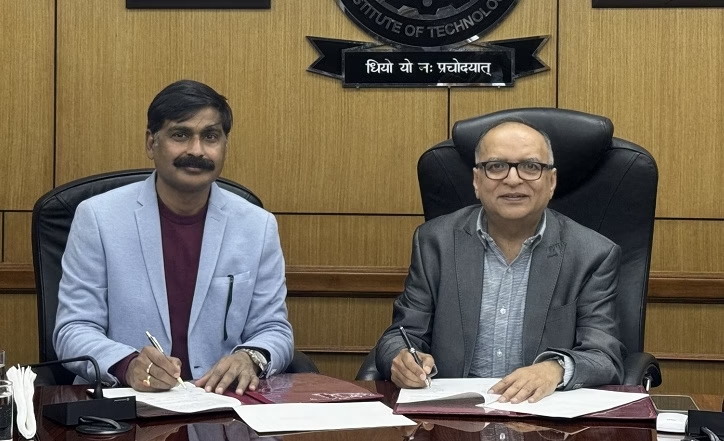
The MoU was signed by Professor Rajeev Ahuja, Director, IIT Ropar, and Professor Sushendra Kumar Mishra, Vice-Chancellor, SBSSU Gurdaspur, marking the beginning of a five-year collaborative framework designed to foster knowledge exchange, provide global academic experiences, and facilitate research advancement.
Under this partnership, both institutions will engage in comprehensive academic cooperation across science, engineering, management, and social sciences. The collaboration encompasses the exchange of faculty, scientists, and students at undergraduate, graduate, and doctoral levels for educational and research purposes. Students from SBSSU will have the opportunity to undertake semester-long training programs at IIT Ropar, while both institutions will facilitate the sharing of laboratory infrastructure for teaching and research activities.
The MoU provides for joint research and development initiatives, with both institutions committing to invite faculty members to participate in sponsored research programs and consulting projects. Additionally, the partnership will promote the organization of seminars, conferences, workshops, and Faculty Development Programs on topics of mutual interest, creating platforms for academic discourse and professional development.
A key feature of the collaboration is the structured student exchange program, where participating students will maintain their full-time status at their home institution while undertaking predetermined programs of study or research at the host institution. Academic credits earned during these exchanges will be recognized subject to institutional policies, ensuring seamless integration into students’ academic trajectories.
This collaboration represents a significant step toward creating synergies between the two institutions, leveraging their respective strengths to enhance educational quality, promote innovation, and contribute to the advancement of knowledge in the region and beyond.