
Punjab’s Groundwater Crisis in Focus: Central University of Punjab Hosts Two-Day State-Level Workshop
Kanwar Inder Singh/ royalpatiala.in News/ February 16,2026
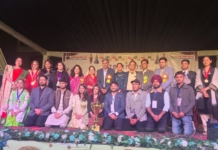
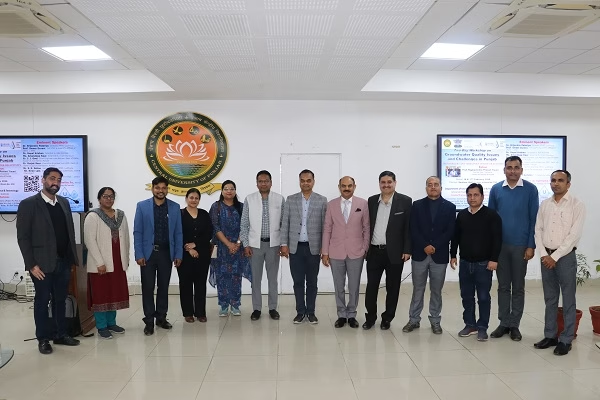
Amid growing concerns over rapid groundwater depletion in Punjab, the Central University of Punjab (CU Punjab) on Monday inaugurated a two-day state-level workshop on “Groundwater Quality Issues and Challenges in Punjab.” The event has brought together eminent scientists, technical experts, and policymakers to deliberate on sustainable solutions to the State’s pressing water crisis.
Organized by the Department of Environmental Science and Technology under the patronage of Vice-Chancellor Prof. Raghavendra P. Tiwari, the workshop aims to equip researchers, students, and stakeholders with practical tools for scientific groundwater monitoring and sustainable management.
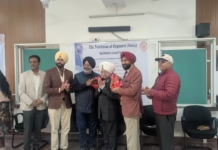
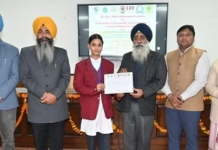
In the inaugural session, Registrar Dr. Vijay Sharma underscored the urgency of addressing groundwater depletion and contamination, calling for evidence-based interventions. Prof. Sunil Mittal welcomed the participants, while Dr. P.K. Sahoo outlined the workshop’s objective of integrating science, technology, and policy for long-term water security.
Delivering the keynote technical address, Ms. Amandeep Kaur, Scientist, Central Ground Water Board (CGWB), presented a stark assessment of Punjab’s groundwater status. She noted that as per GWR Estimates, the State is extracting significantly more groundwater than nature can replenish—28.01 BCM being used against 17.07 available—resulting in 117 blocks being officially categorized as over-exploited.
Dr. Gopal Krishan from the National Institute of Hydrology highlighted how isotope-based techniques act as a “water fingerprint,” enabling scientists to trace groundwater origin, age, and recharge zones, thereby guiding targeted conservation and recharge strategies.
Offering a technology-driven perspective, Dr. Brijendra Pateriya, Director, Punjab Remote Sensing Centre (PRSC), along with Dr. S.K. Sahoo, emphasized that nearly 80–85% of groundwater is consumed by agriculture, compounded by climate change impacts. They advocated the adoption of advanced GIS, satellite, and AI-based tools for real-time monitoring, depletion assessment, and rainfall forecasting.
Addressing drinking water quality, Er. J.J. Goel and Er. Gurjot Kaur from the Department of Water Supply & Sanitation outlined Punjab’s multi-tier monitoring network and mitigation measures, including surface water projects and advanced purification systems. They stressed that achieving safe rural drinking water under the Jal Jeevan Mission requires community participation and a robust 24×7 grievance redressal mechanism.
The first day concluded with a lecture by Prof. Smeer Durani on integrated environmental assessment and advanced analytical techniques for water quality evaluation, followed by a panel discussion.
The workshop will continue on Tuesday with sessions by CU Punjab’s faculty members on uranium and fluoride contamination in shallow aquifers, Punjab’s broader water challenges, and hands-on training in geospatial applications and advanced laboratory instruments.
By encouraging collaboration among scientists, administrators, and stakeholders, the workshop seeks to advance practical, technology-driven solutions for conserving groundwater and ensuring safe, sustainable water resources for future generations.