
GUEST COLUMN: Safeguarding Kashmir’s Wular Lake: Biodiversity conservation amid growing challenges- Mohammad Hanief
Mohammad Hanief/ royalpatiala.in News/ December 27,2025
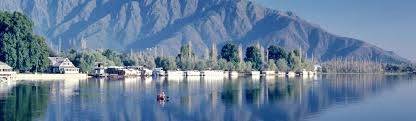
Wular Lake, the largest freshwater lake in the River Jhelum basin, occupies a central place in the ecological and hydrological framework of the Kashmir Valley. For centuries, this vast wetland has functioned as a natural regulator of floods, a reservoir of biodiversity, and a lifeline for thousands of families dependent on its resources. Today, however, Wular Lake finds itself under mounting pressure from unplanned development, climate variability, and prolonged neglect, making its conservation one of the most urgent environmental challenges facing the region.
Situated at the foothills of the Harmukh mountain range, Wular Lake historically spread over nearly 200 square kilometres, acting as a massive absorption basin during periods of high discharge in the River Jhelum. Its ability to store excess water during floods and release it gradually during lean seasons has been critical in maintaining hydrological balance across the valley. This natural buffering system has protected downstream settlements, sustained agriculture, and ensured water availability during dry spells. As climate change intensifies rainfall extremes and alters snowfall patterns in the upper catchments, the importance of this flood-moderation function has become even more pronounced.
Beyond its hydrological role, Wular Lake is a biodiversity-rich wetland of regional and global significance. The lake and its associated marshes form an important segment of the Central Asian Flyway, providing wintering and stopover habitat for thousands of migratory waterbirds. Each winter, species such as Mallard, Northern Shoveler, Common Pochard, Little Egret, and Cattle Egret transform the lake into a vibrant ecological hub. The presence of globally threatened species, including Pallas’s Fish Eagle and the Marbled Teal, highlights the lake’s international conservation value and justifies its designation as a Ramsar Wetland of International Importance in 1990.
Equally vital is the lake’s contribution to the local economy and livelihoods. Wular Lake accounts for nearly sixty per cent of the freshwater fish production in Kashmir, directly supporting between eight and ten thousand fishers living along its fringes. Fishing, water chestnut harvesting, fodder collection, and related wetland-based activities have sustained generations of communities, particularly in the Sonawari region. Water chestnut cultivation, locally known as gaar, covers large portions of the lake during summer months, forming floating carpets that provide both nutritional and economic security to local households. These traditional livelihoods underscore the close interdependence between ecological health and human well-being in the Wular landscape.
Despite its immense value, Wular Lake has suffered decades of fragmented and sectoral development planning. Unlike Dal Lake, which has received sustained political and administrative attention, Wular has largely remained outside mainstream urban and tourism-focused narratives. Developmental interventions in and around the lake have often prioritized short-term economic gains over long-term ecological sustainability. Large tracts of wetlands along the periphery have been drained and converted for agriculture, settlements, and plantations, steadily shrinking the lake’s natural extent.
The construction of flood-protection bunds at various contour levels has further altered the lake’s ecological character. While intended to protect crops and settlements, these structures have fragmented the wetland system and disrupted the natural exchange of water between the lake and its surrounding marshes. As a result, the lake’s ability to moderate floods and retain water during dry periods has been significantly compromised. The unintended consequences of such interventions have become increasingly evident during recent flood events, when a degraded and fragmented lake has struggled to perform its natural buffering role.
Catchment degradation has emerged as another major driver of Wular’s decline. The forests and alpine pastures in the upper reaches of the Jhelum basin, once effective in stabilizing soils and regulating runoff, have been subjected to deforestation, infrastructure expansion, and unregulated land use. Rivers and streams such as Erin, Bohner, Madhumati, Ningal, and other tributaries now carry heavy sediment loads into Wular Lake. Each year, hundreds of tonnes of silt are deposited on the lake bed, progressively reducing its depth and water-holding capacity. Over time, this process has transformed large areas of open water into shallow marshland, altering habitats and accelerating ecological degradation.
The expansion of willow plantations within the lake represents another complex challenge. Initially promoted to meet the growing demand for firewood and timber, willow plantations have spread extensively across the lake’s open-water areas. While they provide short-term economic benefits, their long-term ecological costs are substantial. Willows impede water circulation, degrade fish habitats, reduce biodiversity, and contribute to the physical shrinkage of the lake. Ironically, these changes have undermined the very livelihoods they were meant to support, deepening poverty among communities most dependent on the lake’s resources.
Water quality deterioration is an emerging concern that further threatens Wular’s ecological balance. Nutrient inflows from agricultural runoff, settlements, and untreated waste have led to localized eutrophication, excessive growth of aquatic vegetation, and declining dissolved oxygen levels. Such conditions pose serious risks to fisheries and aquatic life, particularly during warmer months when oxygen stress is highest. Without timely intervention, these trends could severely undermine the lake’s productivity and resilience.
Yet, despite these pressures, Wular Lake continues to sustain remarkable biodiversity. In addition to migratory waterfowl, the surrounding landscapes support a wide range of terrestrial and forest-associated bird species, including the Himalayan Pied Woodpecker, Short-toed Eagle, Monal Pheasant, Alpine Swift, and European Hoopoe. This diversity reflects the deep ecological linkages between the lake, its marshes, forests, and mountain catchments—linkages that must be preserved if conservation efforts are to succeed.
In recent years, there has been a gradual shift in how Wular Lake is perceived by policymakers and environmental planners. The growing recognition of wetlands as nature-based solutions for flood management and climate adaptation has brought renewed attention to Wular’s strategic importance. Restoration initiatives increasingly emphasize protecting the lake’s boundaries, reducing sediment inflow through catchment treatment, restoring hydrological connectivity with surrounding wetlands, and managing invasive or excessive vegetation such as willows. These measures, if implemented in a coordinated and sustained manner, can help restore the lake’s ecological functions and resilience.
Crucially, conservation efforts must be closely aligned with local livelihoods. Protecting biodiversity cannot come at the cost of marginalizing communities who depend on the lake for survival. Sustainable fisheries management, improved value chains for wetland products, and carefully planned eco-tourism centered on birdwatching and cultural heritage offer pathways to link conservation with economic security. Community participation, rooted in traditional knowledge and stewardship, will be essential for ensuring long-term success.
Ultimately, the future of Wular Lake hinges on a shift from fragmented, sector-driven decision-making to an integrated, basin-level approach that recognizes the lake as a living ecological infrastructure. Wular is not vacant land awaiting development, but a critical natural asset that underpins flood security, biodiversity conservation, and livelihoods across the Kashmir Valley.
As climate change accelerates and human pressures intensify, the question facing Kashmir is no longer whether Wular Lake deserves protection, but whether the valley can afford the consequences of its continued degradation. Safeguarding Wular is not merely an environmental necessity; it is a social and economic imperative, central to the sustainable future of the region.

NOTE: The views expressed by the author/ writer are personal. The author is a senior analyst and can be mailed at [email protected] / X (Twitter): @haniefmha