
World Press Freedom Day: Declining Media Freedom in India; royalpatiala.in among those facing pressure
Kanwar Inder Singh/ royalpatiala.in News/May 3,2026
On May 3 each year, World Press Freedom Day is celebrated as a global reminder of the importance of a free and independent media. It underscores how such media empowers citizens with accurate information, enabling informed decisions and supporting a healthy democracy.
However, the scenario has changed significantly. The press no longer remains fully independent. With the corporatization of media, not only governments but also business houses, educational institutions, and bureaucrats often influence it. Across the world, various forces attempt to derail press freedom. Legal attacks—particularly through abusive charges and draconian laws—also play a major role in undermining it. Nevertheless, some journalists and media organizations continue to resist these pressures and uphold fair journalism.
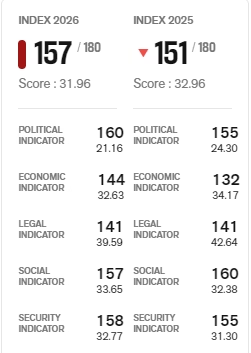
According to Reporters Without Borders, in 2026 Norway ranks first in press freedom with a score of 92.72. In 2026, India, however, is ranked 157th out of 180 countries with a score of 31.96, where allegations of judicial harassment of independent media is reportedly intensifying. This is driven by the growing use of alleged criminal statutes—such as defamation and national security laws—that directly target journalists. In 2025 India ranked 151st with 32.96 global score. Similarly in 2024 India was at 159th rank
Nowadays, genuine reporting has itself become a challenge. Journalists often struggle to write freely or highlight critical issues. Many media houses are influenced by powerful stakeholders, including governments, industrial groups, and educational institutions (as it has become a major industry with large budgets for advertising, paid promotions, and related activities) . These entities may withdraw advertising or financial support, thereby exerting economic pressure.
News portal royalpatiala.in has also reportedly faced pressure from district administrations, police officials, private educational institutions like Chitkara University, Punjabi University’s faculty, powercom officials, PSU officials, industrial houses, government officials etc to not to report, to avoid publishing certain reports , to remove already published content.
A media consultant, speaking on condition of anonymity, said: “If negative news is published, these educational institutions and industrial houses often withdraw their advertising budgets. Due to market pressures, missing in their media and the loss of advertising revenue, media houses are forced to compromise. Management executives try their best to ensure that not a single word against their major clients is published. This behavior emboldens advertisers, and as a result, unethical practices, exploitation of students, faculty, and staff often go unreported.”
In such an environment, the absence of press freedom has serious consequences. When the media cannot function independently, truth is often suppressed and public discourse becomes one-sided. Citizens are deprived of unbiased information, making it difficult to question authority or demand accountability. Over time, this weakens democratic institutions, fosters misinformation, and allows corruption and injustice to go unchecked.
World Press Freedom Day was proclaimed by the United Nations General Assembly in December 1993, following a recommendation by UNESCO. Since then, May 3—the anniversary of the Declaration of Windhoek—has been observed worldwide as World Press Freedom Day.