

AIPEF delegation briefs MP Ladakh against power privatization
Kanwar Inder Singh/ royalpatiala.in News/ May 1,2026
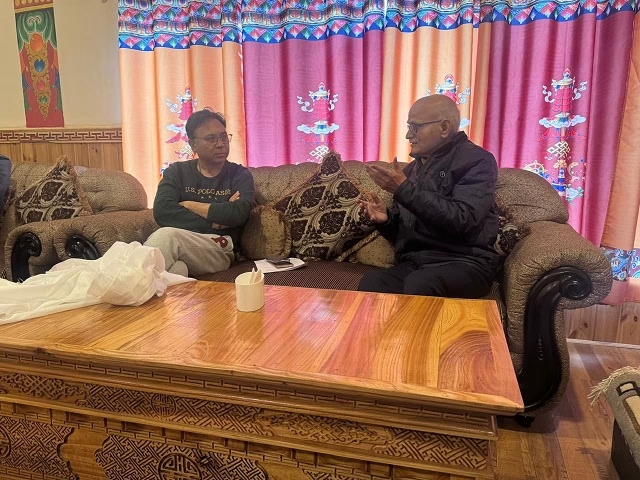
All India Power Engineers Federation (AIPEF) delegation meets Member of Parliament from Ladakh, Mohammad Haneef Jan MP against proposed Joint Venture of Ladakh Power Development Department , a step towards privatization of a strategically critical public utility.
The delegation was led by Shaliendra Dubey, Chairman AIPEF and included President Konchok Ishey and Senior Vice President Aga Murtaza of Ladakh Power Engineers Association, representatives of employees’ organizations.
Dubey explained in detail the serious concerns related to the proposed Joint Venture with REC PDCL and the indirect path towards privatization of the Ladakh Power Development Department. The potential risks to employees, consumers, and the strategic interests of Ladakh were also highlighted. The MP assured the delegation that he will raise this matter before the Home Minister in Leh as well as in Delhi. He will also raise his voice against this issue in Parliament.
AIPEF expresses serious concern that the proposed model prioritizes commercial interests over public welfare, national security, and long-term sustainability of the power sector in Ladakh. The current welfare-oriented functioning of LPDD will be replaced by a profit-driven model, undermining the principle of universal and equitable access to electricity. Though subsidy continuation is mentioned, it remains uncertain and dependent on future budgetary support, exposing consumers to policy risks.
The proposed JV model will inevitably lead to an increase in electricity tariffs due to provisions like Return on Equity (RoE) and commercialization of operations. This will disproportionately affect poor and low-income households in Ladakh, where affordability is already a major concern.
Despite being termed a Joint Venture, the proposed structure effectively transfers control to a corporate entity, amounting to privatization in disguise.
The proposed JV/privatization poses serious risks, such as increased tariffs for poor consumers, loss of sovereign control over critical infrastructure and heightened national security vulnerabilities. While existing employees may be temporarily protected, the future workforce will likely be recruited on contractual terms, weakening job security and institutional strength.










 delegation meets Member of)